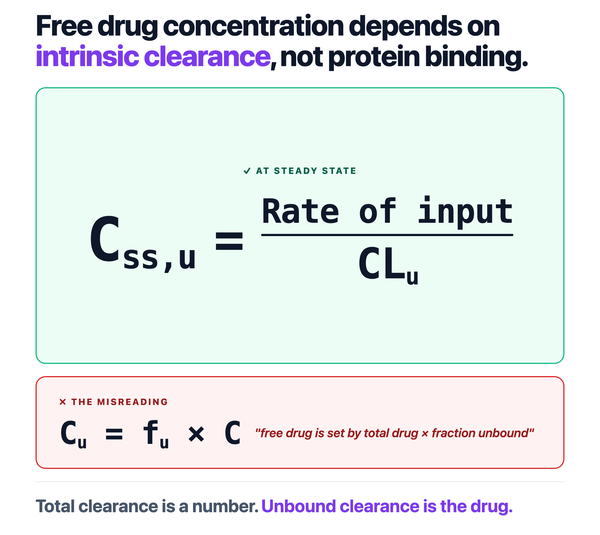
The Free Drug Principle: Why Plasma Protein Binding Doesn't Drive Drug Efficacy
Why plasma protein binding doesn't drive efficacy at steady state. Derivation, worked example, and why "design for higher fu" is the wrong design lesson.

Why plasma protein binding doesn't drive efficacy at steady state. Derivation, worked example, and why "design for higher fu" is the wrong design lesson.

When we started MoleculeInsight almost two years ago, the idea was to make drug discovery concepts more accessible. We wrote about molecular interactions, hit discovery, how drug discovery programs actually get started, the promise and challenges of molecular glues, and other topics. Every article came from the same place: a
The other day, while driving to work, I listened to a podcast featuring Fei-Fei Li, who recently launched World Labs, a company focused on developing spatial intelligence by building large world models. For those outside the field of AI, Fei-Fei Li is a powerhouse, widely regarded as one
In structure-based drug design, it's easy to be misled by the static image of a crystal structure. When aiming to improve the binding between a protein and a synthetic molecule, our natural instinct is often to increase as many hydrogen-bond interactions as possible by adding additional
Whether you're working with data from lab experiments or just curious about coding, this blog series is here to help. Don’t fall into the trap of thinking, “I’m a synthetic chemist or a cell biologist; I’ll never need to code.” The truth is, learning to code will only benefit your career.
Molecular glues are making headlines, with millions of dollars pouring into deals that promise groundbreaking advancements in drug discovery. Companies like VantAI, Neomorph, and Monte Rosa are leading the charge, securing major partnerships with large pharmaceutical firms. But what exactly are molecular glues, how are they discovered, and why are

In the field of medicinal chemistry, change comes slowly. Every few years, someone with access to vast pharmaceutical data conducts a statistical analysis, aiming to identify new rules for drug-likeness. Yet, ironically, these rules seem to evolve more than the field itself. As a medicinal chemist, I've
Generative AI has made remarkable strides in recent years, revolutionising fields like image, text, and even video generation. These advancements are largely due to the vast amounts of data available for training these models. However, in the realm of generative chemistry, there isn't the same volume of data

In my previous post, I promised a follow-up article about targeting non-protein biomolecules. Today, we'll focus on targeting RNA. If you work in drug discovery, you're likely familiar with the current buzz around targeting RNA with small molecules. RNA is an appealing target due
You've identified a biomolecule you want to target (for a refresher on target identification, see our previous article), and now you're ready to launch a hit identification campaign. In this article, we'll focus primarily on small molecule hits for protein targets, while addressing non-
